
This piece was written by the project manager of the YSI-ACT (Youth Action for Solidarity and Inclusion) project. The text describes the YSI – Time to Act solidarity act of the young people who participated in the project: a low-threshold game night organized at Stoppi (Stop Huumeille ry). Through the event, the young people wanted to better understand and reduce the stigma directed at people who use substances. With their actions, they aim to inspire other young people to challenge societal norms and promote change that begins with critical self-reflection.
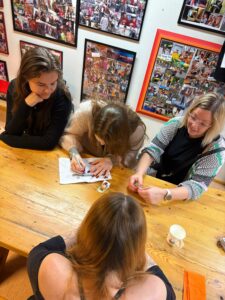
YSI Time to ACT – from words to actions
I have arrived at a pizza night at Stoppi, a meeting place for people in substance rehabilitation, with whom some of the young people have collaborated before. I sit at a table in my role as the project manager of YSI‑ACT, feeling slightly uncomfortable in an unfamiliar environment. However, Stoppi immediately fulfills its promise as a living room for warm encounters. Soon I have a cup of tea in front of me and people to chat with around me. The young participants are setting up a Kahoot quiz on the television screen and encouraging visitors, who are still gathered around the pizza table, to join the game night they have planned.
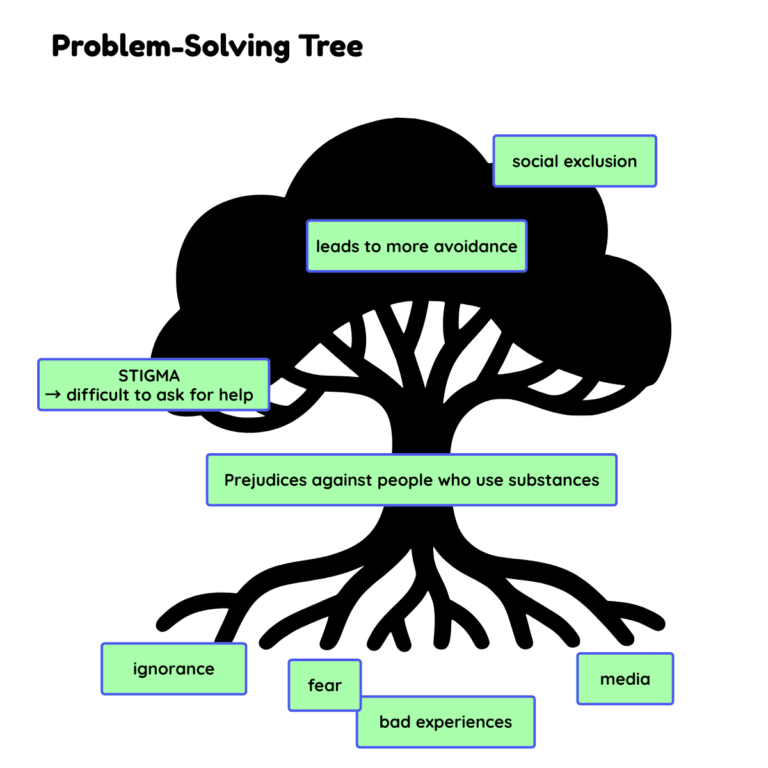
Earlier in the autumn, the young people participated in solidarity workshops organized by the youth workers involved in the project. Participants were recruited from Laurea and especially from the youth workers’ own operating environments. Their involvement culminated in an international camp held in Barcelona, where a group of four young people was selected from among those who took part in the workshops. The aim of the youth‑oriented activities has been to encourage young people to engage in discussion and reflection, and to actively question prejudices, stereotypes, and discrimination (YSI‑ACT Toolkit, 2025). Now it is time to carry out the next phase of the project process: the young people’s own solidarity action, the theme and location of which have been determined based on their shared discussion, reflection, and interests (Image 2: Problem-solving tree).
After moving to the sofas in front of the large TV screen, I feel obliged to explain the project, which aims to strengthen the ability of 16–25‑year‑olds to promote solidarity and inclusion. My project talk seems to disappear into cheerful conversation and the Kahoot music. I shake off my project manager role and quiet down—realizing that now the spotlight belongs to the young people who planned this event. Their goal is to meet people in substance rehabilitation humanely and without prejudice through Kahoot, board games, and open conversation.
Getting Rid of Stigma
The Kahoot begins, and I try to tap the correct answers. The statements deal with prejudices related to substance use. I quickly click a wrong answer and awkwardly blame my reaction time. In truth, the topic is fairly unfamiliar to me. Still, the atmosphere is relaxed; I receive approving looks from the people in recovery sitting on the sofa group, and bursts of laughter can be heard here and there. Humor seems to connect them—and very soon, all of us sitting together.
Yet the topic is serious. Young people’s attitudes toward drugs are increasingly permissive, and problematic use of harmful drugs has risen (Allianssi 2024). The synthetic drug alpha‑PVP, familiar from the news, also comes up in this discussion. I notice that the street name “peukku”, which appears even in media coverage, is barely mentioned here. The Institute for the Languages of Finland (2025) has written in its blog in favor of using the official name of this dangerous substance, since news coverage should not normalize words used in drug slang.
News related to people with substance dependence has caught the attention of the young participants. They are concerned about the stigma associated with people who use substances and want to reduce it. Stigma refers to a negative image that forms because of a person’s identity, background, actions, or illness. It manifests in society as prejudice and discriminatory treatment. Young people are especially troubled by social stigma—the partly distorted image of substance users that the media communicates. (Ministry of Social Affairs and Health 2023, 11.) At worst, news stories create fear and avoidance. Stigmatized people may even be perceived as dangerous and undeserving of help (Rissanen, Jurvansuu & Jalava 2024). One could reflect on this personally by imagining meeting an intoxicated person on the street: does one feel sympathy and concern—or disgust and fear, even crossing the street to avoid them?
Those playing with us share that only a fraction of substance‑use problems are visible in public. For some, the problem is not visible at all. The next Kahoot statement—“A person with substance dependence can work and manage everyday life normally for a long time”—leads to memories of what life was like when one could combine work and substance use without others noticing. Until one day they could no longer manage, and wanted only to use substances alone within four walls.
Another statement appears on the screen: “Addiction is a choice.” Everyone present knows it is false. Yet people with substance dependence are often seen as selfish, with the decision to use substances viewed as a personal choice. Many do not want services for people with substance dependence located in their own neighborhoods—this is known as the NIMBY phenomenon (Not in my backyard). Fear and prejudice are triggered at least when substance dependence becomes visible, when the problem is impossible to ignore (Rissanen, Jurvansuu & Jalava 2024). A person hiding their addiction while leading a working life escapes our notice, but talk of a rehabilitation center or a needle exchange point in one’s neighborhood sparks intense debate.
Courage to Influence and Challenge Prejudices
Mental health issues have been widely discussed in recent years, and stigma around milder mental health challenges has decreased. However, stigma surrounding substance dependence remains strong (Ministry of Social Affairs and Health 2023). Stigma is known to damage self‑esteem, isolate people from relationships, cause suicidal thoughts, or increase substance use even further. Research shows that negative attitudes can change through experience (Rissanen, Jurvansuu & Jalava 2024), and this is exactly what our young participants are exploring. They seek to understand stereotypes and dispel stigma through their game‑night experience. They are ready to examine their own prejudices and encourage others to do the same. In the final phase of the project, the young people will create a video about their solidarity action to be showcased at the final conference in May.
It has been wonderful to travel this road of solidarity with these young people—sometimes simply watching proudly from the sidelines. Along the way, we have shared meaningful conversations, deep reflection, and empathetic encounters. And now, here we are at Stoppi, witnessing the solidarity action they planned, working to understand and reduce stigma. The final statement—“There is no hope for people with addictions”—gets rapid “false” clicks in Kahoot, and this evening itself, the shared stories and this place, already show hope. I wish all young people could understand that their thoughts and actions truly matter.
I am already supposed to be elsewhere, but the intense discussion keeps me engaged. Eventually, we all note that we never had time for any board games. The Kahoot the young people designed served as a great introduction to a conversation that everyone joined from their own background and interest—some based on experience and encounters, others out of curiosity and a desire to learn, eager to challenge their own and others’ assumptions. I thank everyone and feel deeply proud of the young people involved in the project, who at this moment embody the very essence of solidarity. We each head our separate ways—hopefully viewing the world around us a bit more gently.
This text was produced as part of the two‑year YSI‑ACT project, co‑funded by the European Union’s CERV programme, in which Laurea University of Applied Sciences participates as a project partner responsible for implementation and communication. The goal of the project is to strengthen active citizenship attitudes among 16–25‑year‑olds, promote inclusion and solidarity, and combat prejudice and discrimination. The project develops creative and participatory methods that youth workers and other professionals in the field of education can use in their work.
Sources
- Rissanen, P., Jurvansuu, S., & Jalava, J. 2024. Mielenterveys ja nimby: Suomalaisen väestön suhtautuminen mielenterveysongelmiin. Sosiaalilääketieteellinen Aikakauslehti, 61(1), 61-74. Viitattu 24.2.2026
- Sosiaali- ja terveysministeriön julkaisuja 2023:29. Kansanterveyden neuvottelukunnan mielenterveys-, päihde- ja riippuvuusasioiden jaosto. Suosituksia mielenterveyteen, päihdeongelmiin ja riippuvuuteen liittyvän stigman ja syrjinnän tunnistamiseen ja vähentämiseen. Viitattu 24.2.2026
- Stop huumeille ry. 2026. https://www.stophuumeille.fi/ Viitattu 24.2.2026
- Suomen nuorisoalan kattojärjestö Allianssi ry. 2024. Mitä kuuluu nuorille? – Tieto- ja ratkaisupaketti, kunta- ja vaaliohjelma 2025.Viitattu 24.2.2026
- Uusikoski, R. Älä uutisoi peukusta. Kotimaisten kielten keskus. Viitattu 24.2.2026
- YSI-Act työkalupakki – Työkaluja solidaarisuuden, osallisuuden ja aktiivisen kansalaisuuden edistämiseen. 2025.
This is an AI‑generated translation. The original Finnish article was published in Laurea Journal on 3 March 2026.