
What kind of activities take place when 16 young people and their youth workers from four different European countries gather at a camp with the goal of exploring participation, solidarity, and advocacy through drama and theatre methods? This article shares the journey of the Youth Action for Inclusion – YSI ACT project to Barcelona from 15–20 September 2025, where the coordinating theatre organization La Xixa hosted an international youth camp.

The structure of this article follows the dramaturgy of creative group activities: the warm-up section introduces the project and the camp, the action section presents the camp’s content and the meaning of drama work through young participants’ experiences, and the reflection section discusses the camp’s added value for regional development and networking. Finnish youth who participated in the camp reflected on their experiences through written feedback and gave permission to include their comments in this article. These reflections appear in italics and quotation marks.
Warm-Up
The European Union’s CERV (Citizens, Equality, Rights and Values) funding programme aims to protect the EU’s shared values and rights. It is designed especially to support civil society organisations and research (Ministry of Justice). YSI-ACT is a practical example of a project made possible by this funding programme. The project is coordinated by Associació La Xixa Teatre from Spain, with partners Laurea University of Applied Sciences (Finland), Active Bulgarian Society – ABS, and Neolena Gia Antalagi Kai Katanoisi from Cyprus. The project aims to prevent discrimination against vulnerable young people aged 16–25, increase awareness of EU human rights, and empower youth toward active participation. YSI-ACT has also strengthened youth work practices by training professionals working with young people in creative and participatory methods. The trained youth workers implemented workshops exploring themes of participation in each partner country.
These workshops used drama, theatre, and other creative methods to explore participation, solidarity, and advocacy. In Finland, three workshops were held at Laurea’s Tikkurila campus and three at the youth activity centre Leikkivä, which provides rehabilitative workshop activities for young people outside education and employment, often due to mental health challenges.
A total of 24 Finnish young people took part in the workshops. Based on applications and life situations, four were selected to join the camp in Barcelona. Before travelling, the Finnish group met once to discuss aims and schedules. In addition, all participating youth across countries met once online. This small-group meeting was an important step in preparing and building trust for the experience ahead.
Creative and theatre-based methods were used both in the workshops and at the camp to strengthen young people’s emotional, interaction, and participation skills. Drama work is particularly impactful because all participants work together, requiring both physical and psychological presence. Participants can explore emotions and thoughts through action—sometimes by stepping into fictional situations and embodying roles, and at other times by observing the theme from an external viewpoint. This combination is exceptionally fruitful, educational, and rewarding (Toivanen 2016).
Action: 3–2–1 ACTION!
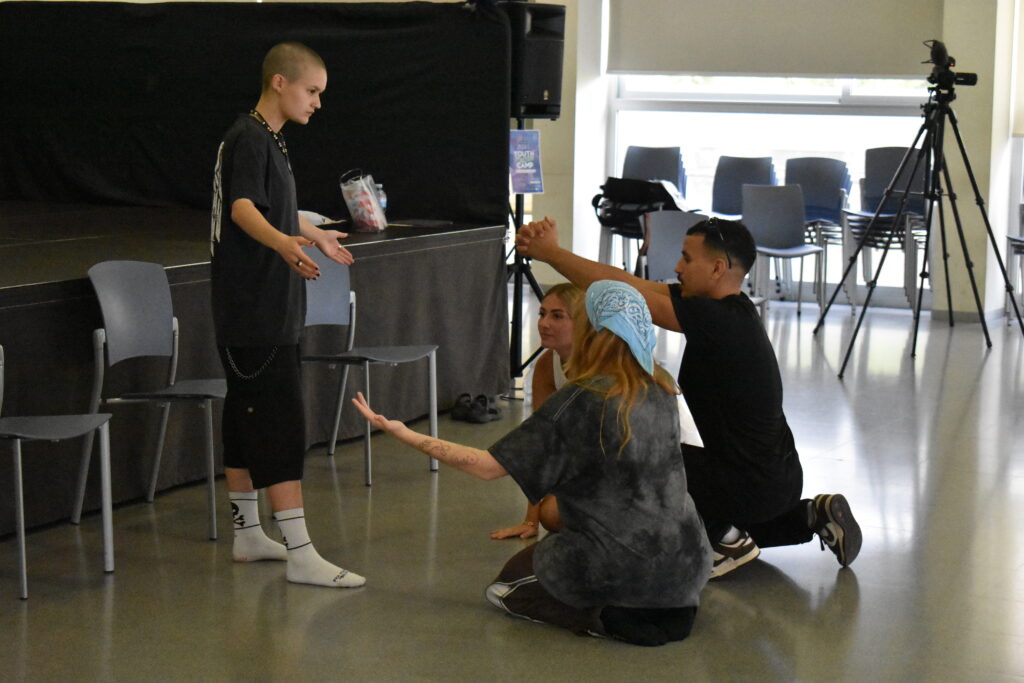
This countdown-style phrase is familiar from Forum Theatre, one of the main methods the youth learned and practiced at the camp. Forum Theatre, developed by Brazilian theatre practitioner Augusto Boal, is a form of participatory theatre aimed at finding solutions to oppressive or dysfunctional situations and empowering people in the process. In Forum Theatre, scenes depicting social injustice or oppression are performed and then collectively examined (Jansson 2015). The audience is invited to analyse and propose solutions—either by giving instructions to actors or stepping into roles themselves. Another variation involves small groups creating their own scenes based on real-life situations they want to change (Ventola & Renlund 2005). This latter format was used at the Barcelona camp.
Before creating Forum Theatre scenes, the group spent a day and a half getting to know one another and exploring participation and solidarity through sociometry and story theatre methods. According to the youth, we succeeded in creating familiarity and safety among participants: “The best part was meeting new people and cultures, and learning different drama methods.” “The most meaningful thing was doing things together and being able to be myself. Sharing ideas and thoughts. Connecting with other young people.” “I want to thank the group for being so welcoming and for the good team spirit that created a safe space.” and “I learned to be more open about my thoughts. I can say what I think—I don’t have to stay silent to please others.” These reflections highlight the importance of connection and sharing ideas.
We also explored Forum Theatre by visiting a theatre group of young asylum seekers. Their performance portrayed the difficult situation in their home country, their escape across the sea, and their process of building a new life in Spain. This experience deeply moved all of us: “We saw a performance based on the group’s own experiences as asylum seekers. It was emotional and taught us more about Forum Theatre. The whole experience was unique and educational.” The performance made visible the reasons people leave their homes seeking safety and better living conditions in Europe. One youth wrote: “Through drama you can express and process difficult and complex themes physically, and even without words. It can be a way to work through trauma.” This reflects findings from Ramdath’s (2016) research on Forum Theatre with immigrant youth in Canada, where key benefits included making difficult experiences visible, receiving community support, strengthening expression, and increasing confidence and agency. Forum Theatre fosters responsibility that extends beyond the performance itself, and contributes to hope and clarity about personal goals.
The camp youth were motivated, open, and brave in expressing emotions and exploring topics through action. The camp culminated in presenting small-group Forum Theatre scenes during the final celebration.
These youth-created scenes explored participation, care, the importance of journalism, intervening in bullying, and everyday acts of solidarity. For every challenge presented on stage, the audience was invited to try new solutions by stepping into roles and acting differently than in the original scene.
As one young person reflected: “Our performance dealt with an oppressor and an oppressed group. Talking about Palestine was important to all of us, and I’m proud of how we expressed it.” Another wrote: “Working on difficult issues through drama felt amazing. You could show what you think and try out what it feels like to act according to your values in a challenging situation.” These comments illustrate how Forum Theatre makes diverse interpretations and solution strategies visible (Jansson 2015).
Reflection on significance
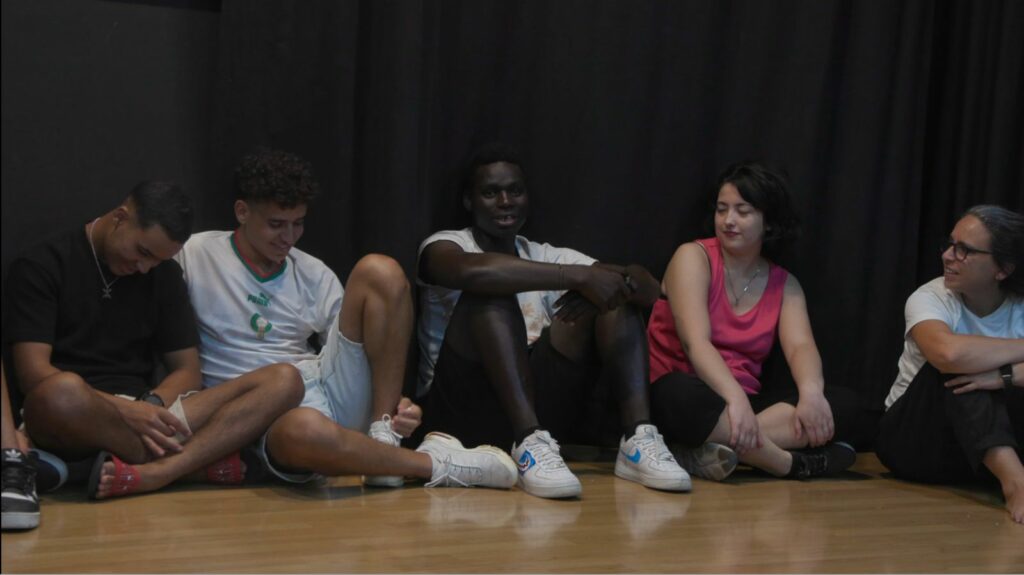
“I feel that drama methods or theatre hobbies help practice many skills that are useful in (working) life.” This statement captures the essence of drama work. According to Siren (2016), artistic processes require vulnerability and the sharing of experiences, which deepens trust among participants. Creative encounters are equalising and can break down hierarchies, strengthening both group cohesion and individual growth. Creating a theatre performance involves the assumption that everyone can take responsibility and collaborate—skills essential in work life and life in general.
“The most important thing for me was the overall experience and the thoughts it inspired… I also learned how drama can be used to explore many different topics.”
Drama methods are indeed versatile. According to Heikkinen (2017), they support the exploration of knowledge, skills, emotional learning, and citizenship. Through drama, participants gain insights about themselves, how they relate to others, and how they understand culture.
Youth also wrote: “I gained new inspiration and energy. My passion for theatre was reignited. I got a lot of ideas from others to take home.” and “I was able to let go of control (a little) and throw myself into the activities.” These comments reflect strengthened self-understanding and a sense of belonging. Four days is a short time, but sometimes that’s enough for something powerful to happen.
As someone who has worked as a drama instructor and teacher for nearly 30 years, I am still amazed by the power of collective creative work. Sixteen young people from across Europe worked together for four days, exploring themes of participation through drama. They did not share a common theatre background, strong language skills, or cultural similarities, and most were strangers to each other. The work was sometimes chaotic, schedules slipped, and at times we doubted whether the performances would be ready. Yet—perhaps because of these challenges—the magic of theatre happened once again. The performances moved, inspired, and empowered us, creating hope for the future. The world becomes a better place when we work together to change it.
CERV-funded projects are sometimes seen as labour-intensive or not financially profitable. However, they align well with universities of applied sciences’ mission to meet the needs of working life and its development. The funding enabled YSI-ACT to collaborate with local youth work organisations and international training providers. This cross-pollination with non-formal learning actors is valuable for the development of higher education pedagogy. And the impact does not end with the camp: the young participants will now start planning their own workshops, forms of advocacy, and initiatives in their home countries. More to come!
References:
- Heikkinen, H. 2017. Ajattele toimien. Kohti draamakasvatuksen syvempää ymmärtämistä. Tampere: Draamatyö.
- Jansson, S.-M. 2015. Teatteri ja draama työn oppimismuotoina. Aikuiskasvatus, 35(4), 312–315.
- Oikeusministeriö. CERV-rahoitusohjelma. Referenced 14.10.2025.
- Ramdath, K. D. 2016. ‘The Use of Forum Theatre as Therapy with At-risk Immigrant and Refugee Youth’, ProQuest Dissertations & Theses, University of Calgary, Calgary, Canada.
- Siren, K. 2016. Teatteri yhteiskunnallisen osallisuuden tilana. Taiteen menetelmät kehittämisessä ja tutkimisessa. Eduskunnan tulevaisuusvaliokunnan julkaisu.
- Toivanen, T. 2016. Teatterilähtöiset menetelmät vuorovaikutusosaamisen kehittämisessä. Taiteen menetelmät kehittämisessä ja tutkimisessa. Eduskunnan tulevaisuusvaliokunnan julkaisu.
- Ventola, M-R & Renlund, M. 2005. Draamaa ja teatteria yhteisöissä. Helsinki: Helsingin ammattikorkeakoulu Stadia.
This is an AI-generated translation. The original article in Finnish was published in Laurea Journal on 9 December 2025.